
There’s a particular kind of charm to a well-designed small space, and this converted bus leans all the way into it. Set on a sun-washed summer homestead, it blends rustic practicality with a surprisingly polished interior language: warm wood, matte black accents, soft linen textures, and just enough modern detailing to keep it feeling crisp rather than quaint. From the outside, it still carries the honest silhouette of its former life, but inside, the mood shifts into something calm, clever, and deeply livable.
What makes this home memorable is how thoughtfully every inch has been considered, almost the way I think through a compact kitchen before a big meal: workflow first, beauty close behind. As a concept design, it imagines off-grid living not as a compromise, but as a more intentional way to inhabit space, with built-in storage, layered natural light, and rooms that feel personal rather than performative. The result is cozy, yes, but also refined in a way that catches you off guard.
Exterior
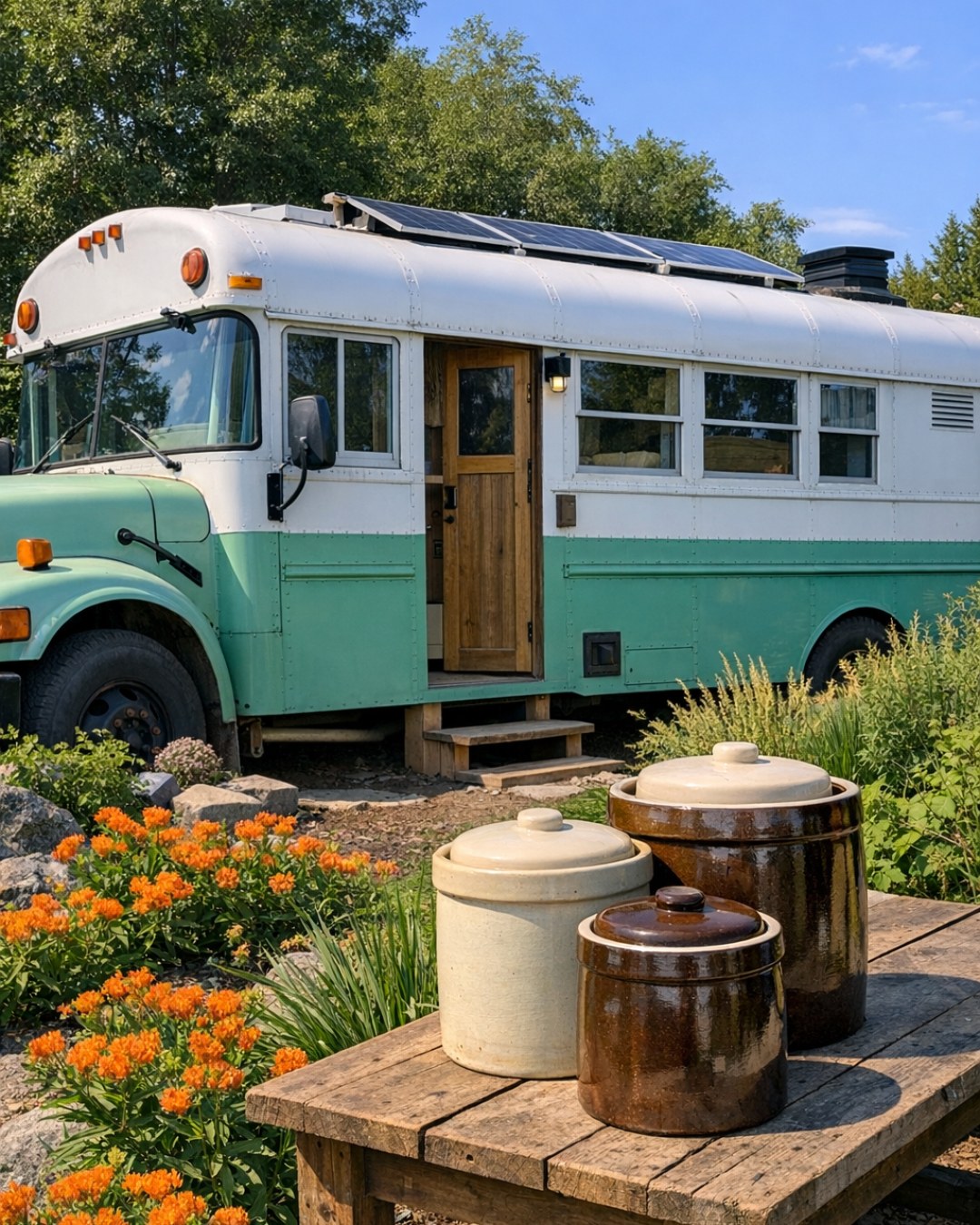
The bus exterior keeps its utilitarian roots visible, which I think is part of the appeal. Rather than disguising the shell entirely, the design works with it through a soft, earthy paint palette in faded sage and cream, punctuated by black-trimmed windows and simple brass porch lights near the entry. A modest timber platform extends from the side like a little front porch, grounding the vehicle in the landscape and giving it the welcoming posture of a cottage. Potted herbs, galvanized planters, and a gravel path reinforce the homestead setting without tipping into costume.
What I like most is the balance between mobility and permanence. The roofline is fitted with solar panels in a tidy, low-profile arrangement, and the bus is parked beneath a light canopy of trees that dapples the metal skin with shifting summer shade. A retractable awning and a pair of folding wood chairs suggest long afternoons outdoors, while the overall composition remains clean and restrained. It feels self-sufficient and relaxed, the sort of place where muddy boots by the step would look perfectly at home.
Living Room
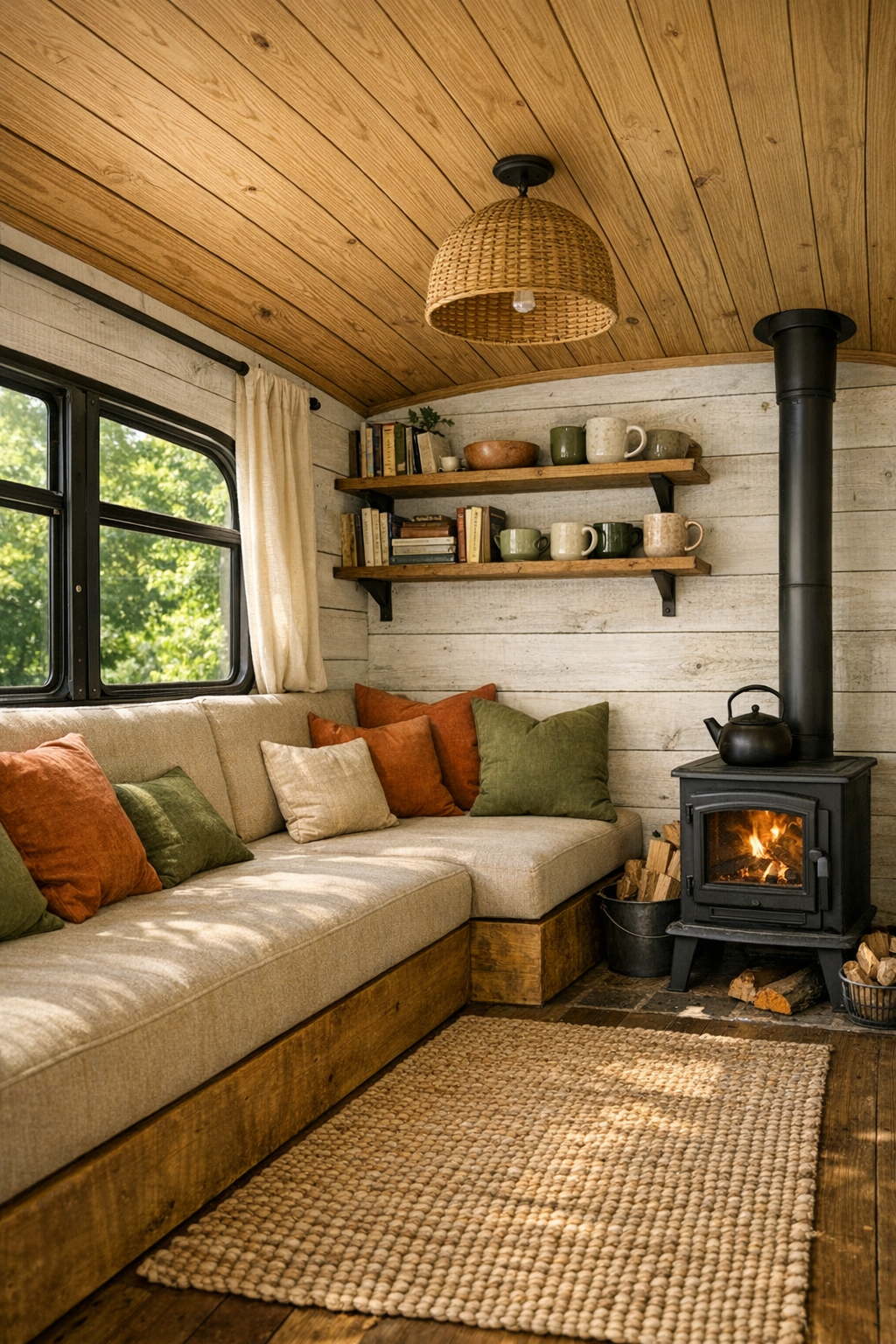
The living area sits just inside the main entry, and it immediately sets the tone with a built-in bench sofa wrapped in oat-colored upholstery and layered with rust, olive, and cream pillows. Because the bus walls curve inward, the millwork has been shaped to follow them, which gives the room a custom-fitted feel you simply don’t get in standard interiors. Whitewashed plank walls brighten the narrow footprint, while a honey-toned wood ceiling adds warmth overhead and draws the eye lengthwise, making the space feel larger than it is.
A compact wood stove becomes the visual anchor at one end, balanced by open shelving filled with books, ceramic mugs, and a few everyday objects that make the room feel lived in rather than staged. There’s a slim nesting coffee table in blackened steel and oak, a woven jute rug underfoot, and soft wall sconces that cast a buttery evening glow. The windows do a lot of the heavy lifting here, framing meadow views and bringing in light from both sides, so even with the snug dimensions, the room feels airy and unforced.
Dining Room
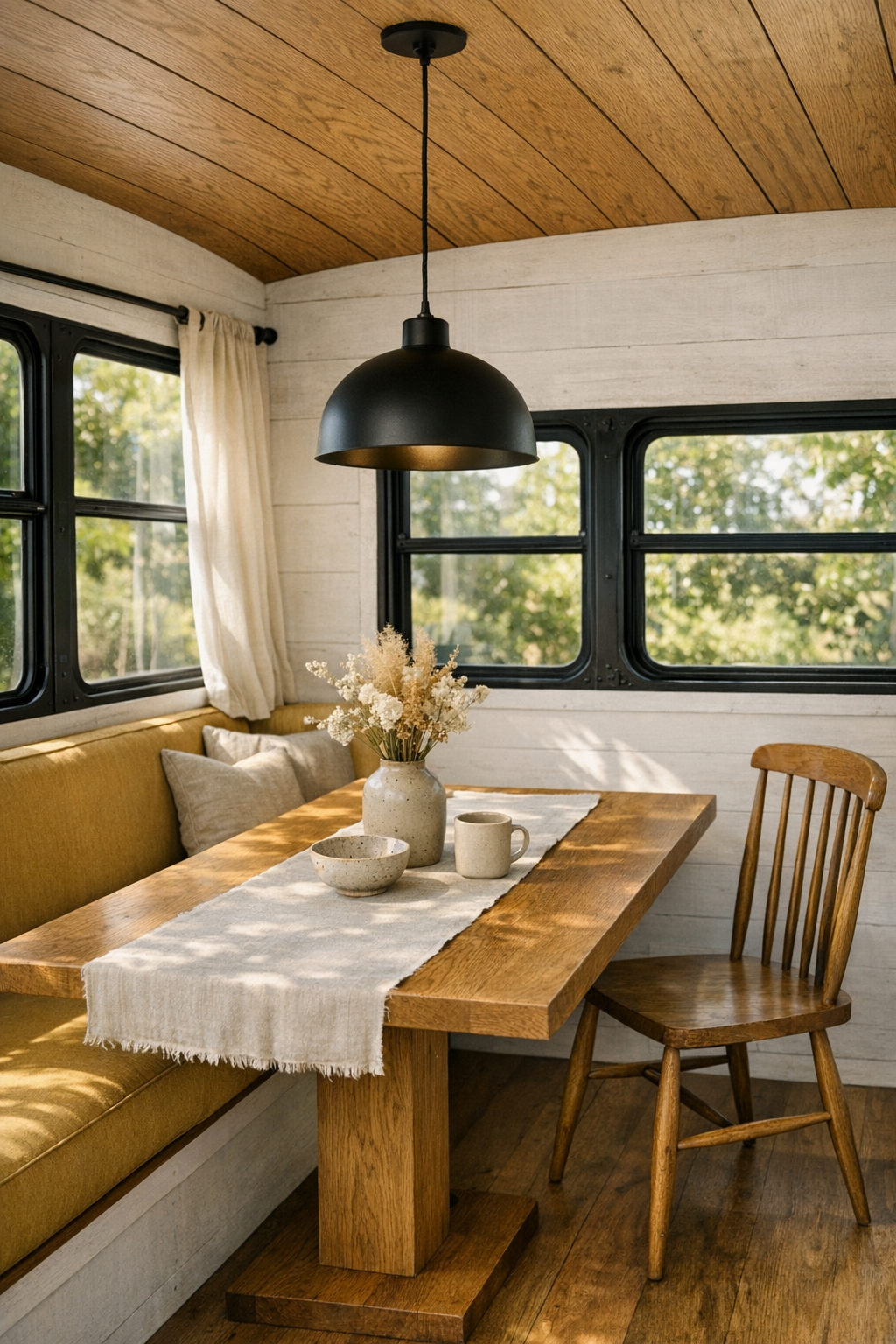
In a home this size, the dining area has to earn its keep, and this one absolutely does. A petite built-in table in solid oak tucks against the window line, paired with a bench on one side and a single spindle-back chair on the other to keep circulation easy. I appreciate how the design avoids bulk; the tabletop is thick enough to feel substantial, but visually light, and the seating slips neatly beneath it. Overhead, a small dome pendant in matte black gives the space just enough definition without crowding the ceiling plane.
The palette stays consistent with the rest of the bus, but there are subtle shifts that make the area feel distinct. A narrow cushion in muted mustard softens the bench, and a linen runner introduces a touch of softness against the grain of the wood. It’s the sort of table where you could have coffee with the windows open in the morning or set out a simple supper at dusk, and because it sits so close to the kitchen, it has the practical intimacy I always love in compact homes. Everything feels within reach, but never cramped.
Kitchen
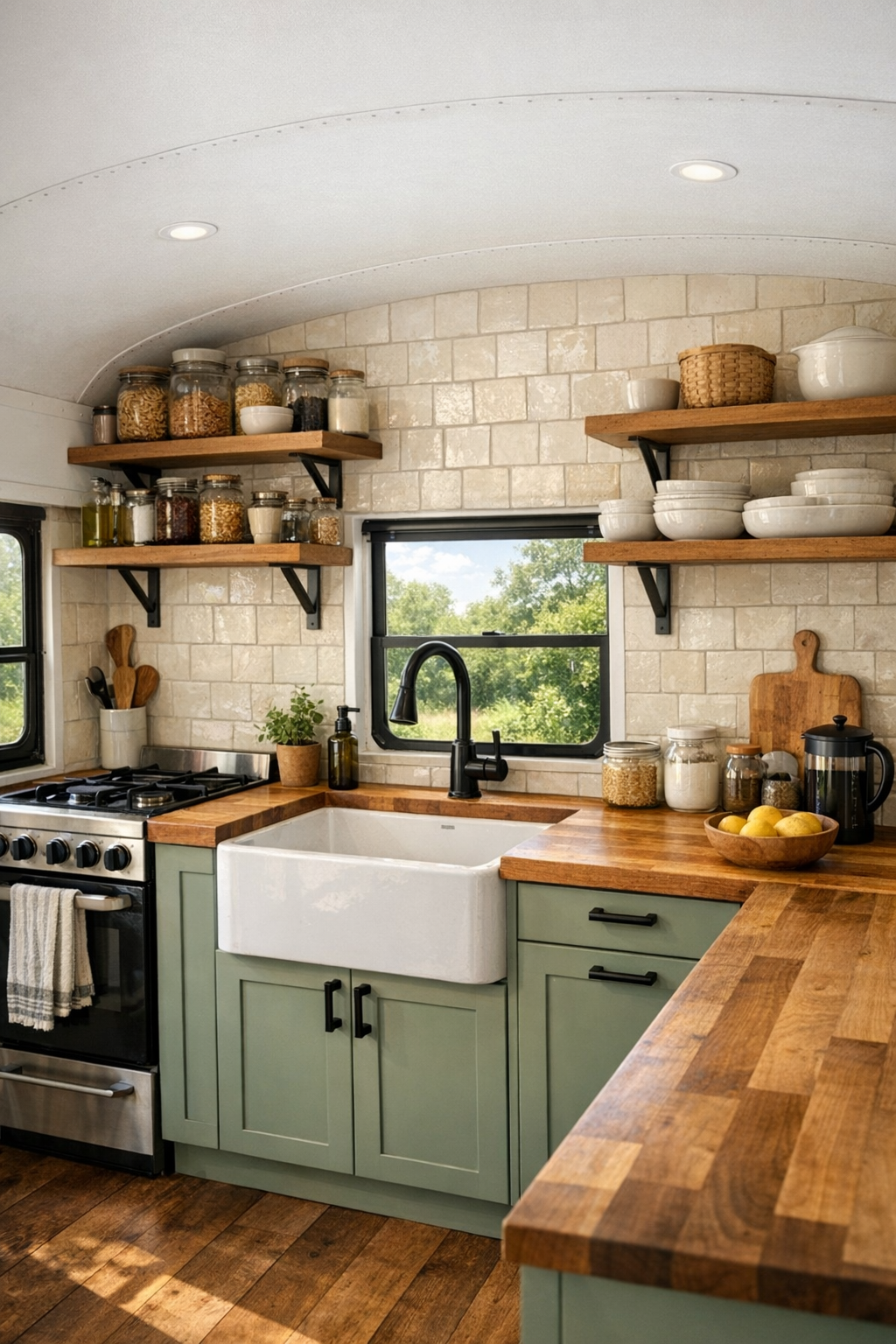
The kitchen is where this bus really wins me over. As someone who spends a lot of time cooking, I notice immediately when a compact kitchen has been planned by someone who understands movement, prep space, and storage. Here, one side is devoted to a galley run of flat-front sage cabinetry with butcher-block counters, while the opposite side carries open shelving, a magnetic rail for utensils, and a narrow ledge for oils, spices, and a pot of basil. It’s efficient in the best sense, with every surface designed to support actual use.
A deep farmhouse-style sink sits beneath a window, which is exactly where I’d want it, and the fixtures are kept simple in matte black to tie in with the rest of the hardware. There’s a compact propane range, a paneled undercounter refrigerator, and drawers organized for cookware instead of fussy filler cabinets. Cream zellige-style tile creates a softly irregular backsplash that catches light beautifully, and I can easily imagine late afternoon sun warming the counters while a pot simmers on the stove. For an off-grid setup, it feels remarkably generous, even to a cook with high standards.
Bedroom
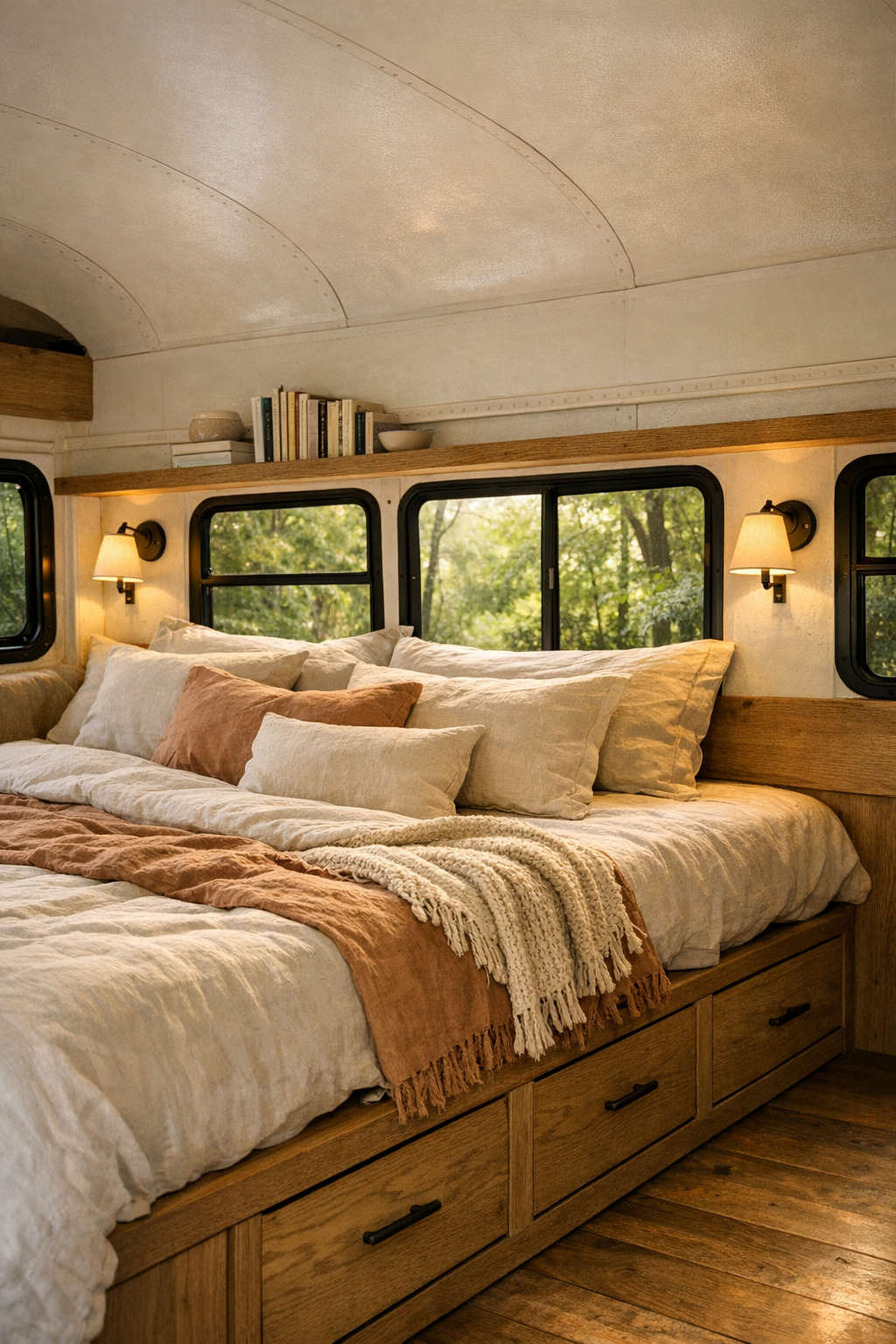
The bedroom is tucked into the rear of the bus, and the design wisely treats it as a retreat rather than simply a place to fit a bed. A raised platform bed stretches wall to wall, dressed in washed linen bedding in soft ivory and clay, with under-bed drawers built seamlessly into the base. The joinery here matters: clean lines, flush fronts, and oak edging give the storage a furniture-like quality rather than making it feel overtly utilitarian. Surrounding windows bring in tree views and cross-breezes, which softens the compact dimensions immediately.
What keeps the room from feeling tight is the restraint in both palette and decoration. There are simple plug-in sconces for reading, a narrow shelf for books and a carafe of water, and a woven wool throw folded at the foot of the bed for texture. I also like the use of soft, natural textiles against the harder shell of the bus; it’s a smart contrast that makes the space feel restful. Instead of trying to over-style the room, the design lets light, material, and proportion do the work.
Bathroom
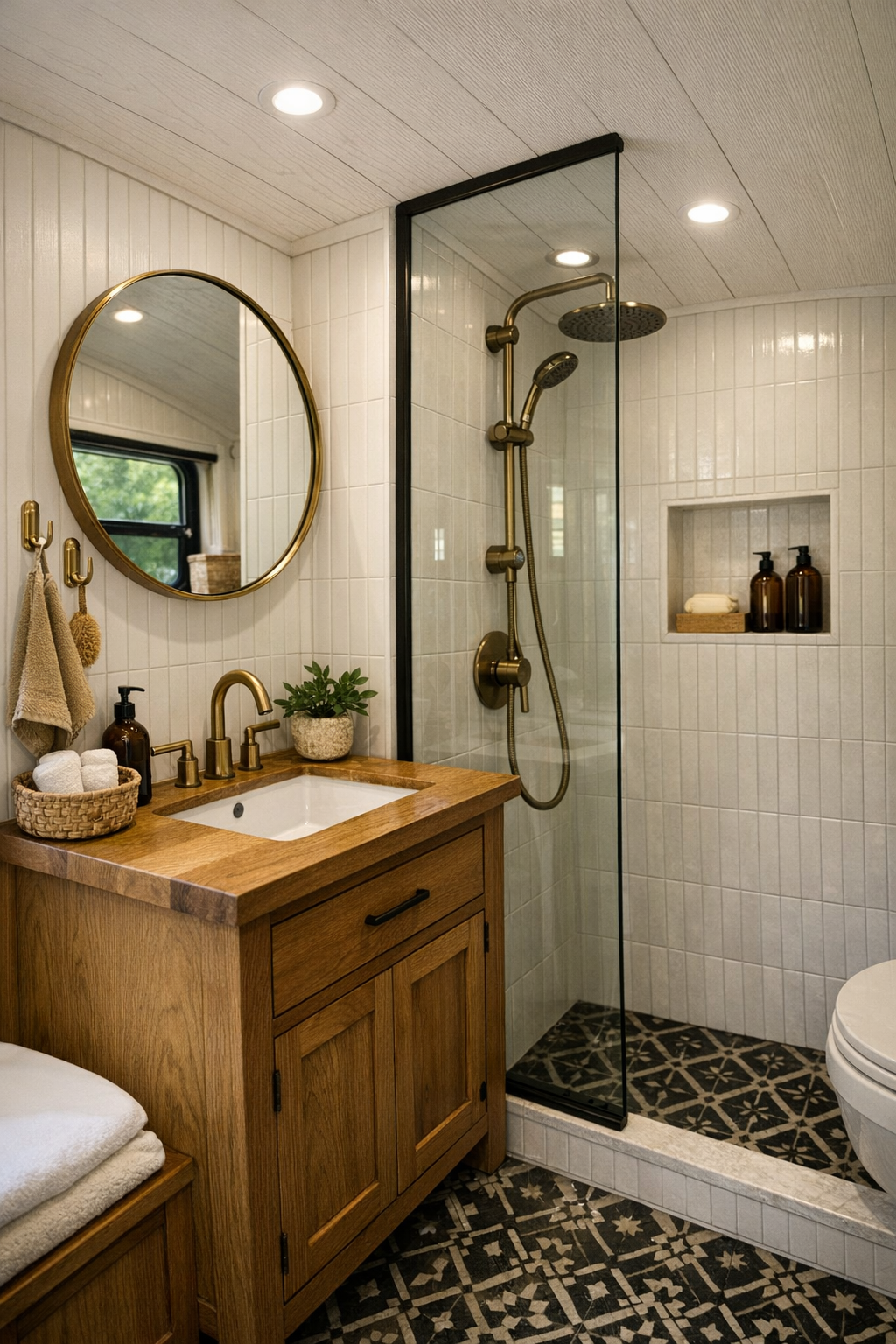
The bathroom is compact, as expected, but it doesn’t feel like an afterthought. A small vanity in warm oak supports a stone-look sink basin, while the wall behind it is lined in vertically stacked off-white tile that subtly elongates the room. Brass hooks and a rounded mirror add a little softness to the geometry, and the floor shifts to a dark encaustic-inspired tile that grounds the whole composition. It’s a nice lesson in how a few material changes can create a sense of room within a very tight envelope.
The shower occupies the back corner behind a clear glass partition, which helps preserve sight lines and keeps the space from feeling boxed in. I especially like the practical details: a recessed niche for soap, a slatted teak mat, and a small operable window for ventilation. The fixtures are minimal and durable, chosen more for longevity than flash, which suits the off-grid ethos beautifully. The room feels clean, bright, and easy to maintain, which in a home like this is every bit as important as looking good.
Other Areas
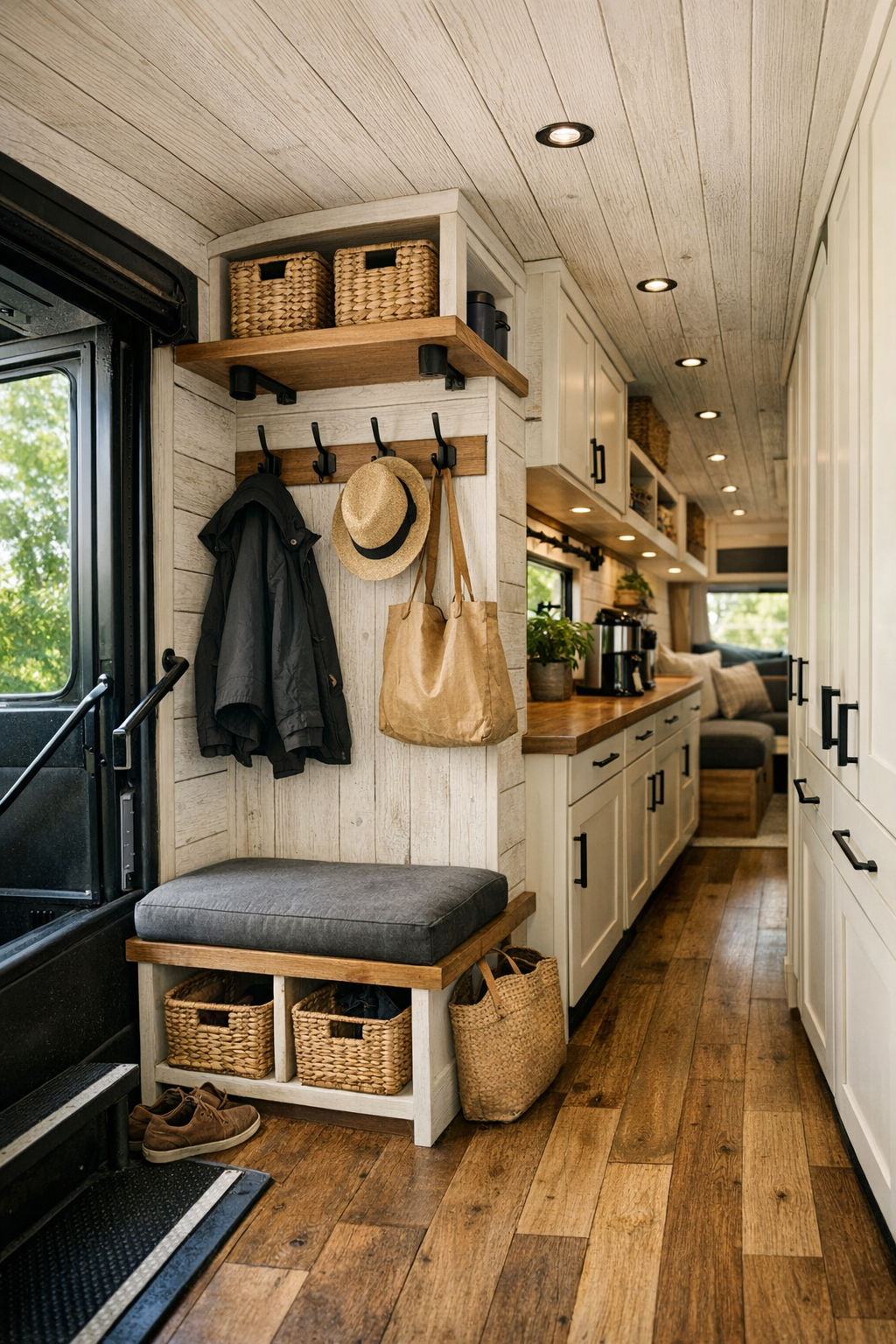
Some of the smartest moments in this bus are the transitional ones. The corridor spaces are lined with shallow cabinetry, overhead cubbies, and little built-in moments that turn leftover edges into useful storage. Near the entry, there’s a mudroom-style drop zone with pegs for hats, a boot tray, and a bench lid that lifts for utility storage, which feels especially right for a homestead setting. Even the steps are doing double duty, with concealed compartments tucked into the risers.
Above, the ceiling line is used beautifully for baskets, lanterns, and neatly integrated lighting, while a small work perch near one window creates space for journaling, bill-paying, or planning the garden. These are the details that make compact living feel generous rather than restrictive. Nothing is wasted, but nothing feels overly engineered either; the home has an ease to it, as though all these functions arrived naturally. That’s a hard balance to strike, and this design handles it with real confidence.
Why You'd Live Here
You’d live here if you wanted your home to feel edited, purposeful, and deeply connected to daily rhythms. This bus offers the romance of summer fields and off-grid independence, but it backs that up with something more important: good design that understands how people actually move, cook, rest, and store their things. I’m always drawn to homes that make ordinary routines feel a little more intentional, and this one does that with remarkable poise.
More than anything, it proves that small living doesn’t have to feel sparse or improvised. With its warm materials, practical layout, and quietly confident style, this converted bus delivers comfort without excess and personality without clutter. If the dream is to live a bit closer to the land while still keeping beauty and function in the same conversation, this is exactly the kind of place I’d want to come home to.